Thursday, August 16, 2007

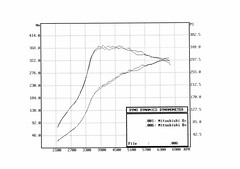
Evo X gear ratio comparison

Assuming the Evo X is running 245/40/18 and the Evo 8/9 are running 235/45/17. Theoretical top speed:


Evo X SST (6 speed)Evo X 5 speedEvo 8/9 6 speedEvo 8/9 5 speed
1st58.164.463.767.3
2nd89.694.395.396.1
3rd121.0127.3129.2129.8
4th160.5167.8168.4171.0
5th210.5241.6213.4246.3
6th273.8N/A267.3N/A


Figures are in km/h with 7000 RPM limit.

Graphically:


Monday, August 06, 2007

Another day, another dyno run...

Nothing serious today. Just a straightforward tune-up. The car has the basic mods (intake/exhaust), boost controller, bigger injectors for safety. Cams, head and bottom end are still stock.

Boost is between 1.5 to 1.6 bar from 3500 to 6500 RPM, whereupon it drops to 1.4 bar.

Final numbers are 376.6 Nm @ 4000, 304.2 PS @ 6583. All figures are at wheels.

Analysis: 90% of peak torque is available over 34.6% of the rev range. 80% is available over 53.8% of the rev range.


Thursday, August 02, 2007

Fun-filled dyno day...

Continuing the Valentine's Day tune... the same car went on to make 465 HP on the same dyno in March.

Somewhere between then and now, the car had new mods. ;)

Today was the day we found out just how effective they were. And this time we went to a Dyno Dynamics dyno, which reads notoriously low. A stock 2007 2.5L STI driven straight from the showroom will read 210 PS at wheels on this.

So the car is set up on the dyno and a small crowd gathers. The operator makes the base run and the line goes off the charts. No kidding. The operator has to rescale it to the 500 PS range and it shows 422 PS at wheels. Double that of a stock STI.

Next I get to work trying to bring up the mid-range and upper end... then we run into problems. It seems the injectors are running out of flow at the top, so it's back to the workshop to swap out for 950cc injectors.

After some time and it's back on the dyno. We make another base pull and now it's down to 310 PS at wheels. DAMN! The owner almost had a heart attack... :> He thought the momentary lean condition earlier in the day had hurt the engine.

So I get right to work with the new injectors... and in the next run the car immediately makes 422 PS again. That's how accurate this dyno is. We make a total of 16 pulls and it was accurate down to 0.1 PS every single time. Eventually we had to stop because the clutch was starting to slip... but it was a fruitful day since we managed to bring up the mid-range by 60+ PS at wheels... all this on 1.6 bar boost and 98 RON.
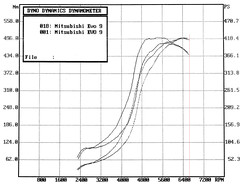
418 PS at wheels
Click for larger view of the actual dyno sheet.

Here is the same data of the run but re-formatted as an Excel graph. With the wider x-axis the drop-off from peak torque does not appear as exaggerated. And this is where things get interesting: a reflashed Evo 9 does between 305 PS to 315 PS at 6500; this car is doing that at just 4700 RPM! From 4500 to 5000 RPM, the car gains an additional 108.8 PS at wheels! :) The torque stays above 460 Nm between 4750 to 6500. So when this car gets a full head of steam, it doesn't let up because the gear ratios are right on the money.

Sunday, July 15, 2007

Torque and HP for the umpteenth time

I don't know why supposedly intelligent gear-heads would state that "HP sells cars and torque wins races."

If this were true, F1 cars would have turbo-diesel engines and 40 speed gearboxes.

Perhaps the misunderstanding arises from the failure to understand the importance of the width of the power band and gearing. For race applications, you want as much torque to be developed as late as possible, for as long as possible. Why? Simply because horsepower is a function of both torque and RPM. So a high torque value at a high RPM will yield a higher HP figure. And if it's broad enough, you can make use of gearing to produce the desired torque at wheels.

Radical SR8LM

Radical Motorsports announced the Radical SR8LM on 1 July, a 2.8L normally-aspirated motor producing 455 bhp with a rev limit of 10,500 RPM.

"Gotcha!" I hear you say. "Didn't you previously have a blog entry that stated 300 whp from a normally-aspirated 2.4L is improbable in the local context? So how do you explain a 2.8L engine doing almost 100 bhp more?"

Let's do the math.

Since Radical doesn't post up the power graph, let's assume peak power of 455 bhp is achieved at 10,000 RPM. This would yield a torque of 239 lb-ft at that engine speed. 2.8L is 171 cubic inches, so BMEP is 211 psi. Well within reason. By the way, Radical suggests an engine rebuild interval of 30 hours. This engine is not meant to be driven daily.

So logic prevails. I stick with what was stated previously and would require a lot more convincing that a daily-driven, locally built and tuned 2.4L normally aspirated engine revving to just 8000 RPM is capable of 300 whp.